
Understanding who is most affected – and where – helps Louisiana Cancer Prevention & Programs (LCP) target prevention efforts where they are needed most. Our team uses statewide cancer data to highlight disparities, track progress, and inform strategies that support healthier communities in Louisiana.
Louisiana’s State Cancer Plan.
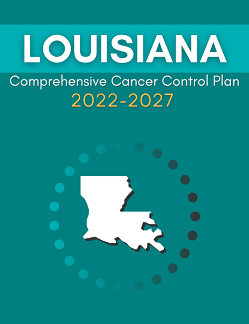
Every five years, LCP partners with other state health organizations to produce the Louisiana Comprehensive Cancer Control Plan (also referred to as The State Cancer Plan). This comprehensive, data-driven document includes statistics on preventable cancers, evidence-based screening recommendations and clear goals, objectives and strategies to reduce cancer risk and improve outcomes statewide.
The plan serves as a shared roadmap for public health agencies, healthcare providers, community organizations and policymakers to help align efforts, guide funding priorities and support coordinated action across Louisiana.
DATA MAPS
Cancer Screening Rates Across Louisiana.
Explore comprehensive cancer screening rates across regions of Louisiana with our interactive data maps. Gain insights into mammography, colonoscopy, and cervical cancer rates, empowering informed decision-making for healthcare providers and policymakers.
PROGRAM IMPACTS
Advancing Cancer Prevention In 2025.
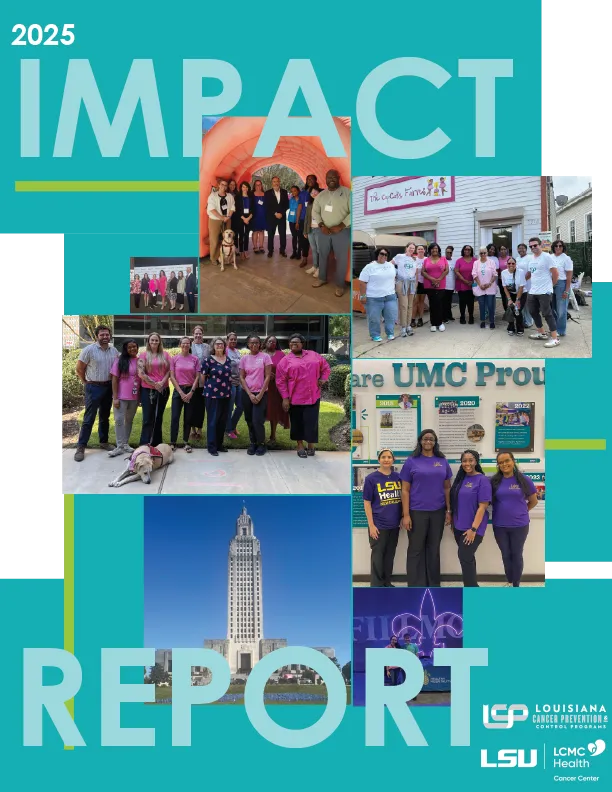
The 2025 LCP Impact Report highlights key activities and accomplishments around the following areas: community outreach and education, partnerships for cancer prevention and control, clinical services and health systems change, cancer research, and strategic communications.
ST. JOHN PARISH CANCER REPORTING
CRISP Report Results In EPA Action.
According to the EPA, “The CRISP 2022 Report concluded there was a ‘likelihood of chronic exposure to low doses of chloroprene at levels [from the Denka facility] which may have potential health impacts on vulnerable populations.’ The Report also stated that “Fifth Ward Elementary School students may potentially face unacceptably high cancer risks based only on the years of school attendance.”
Finally, the CRISP 2022 Report found detectable levels of chloroprene even during periods of reported Denka facility shutdowns.” Also, “The recommendations from the CRISP 2022 Report provided Louisiana Department of Health (LDH) and Louisiana Department of Environmental Quality (LDEQ) with practical steps to potentially reduce and prevent chloroprene exposure in the St. John the Baptist Parish community.”
The CRISP 2022 Report made several recommendations to LDH, including:
- Engage in monitoring, mitigation, and exposure prevention, including conducting health assessments and tracking health outcomes
- Implement a school-based health surveillance system
- Use air monitoring and biomonitoring to quantify resident and child exposures to chloroprene
- Work with LDEQ to establish a relationship with the community and to adopt precautionary practices and policies preventing the future siting of industries next to residential and community spaces
St. John The Baptist Parish Chloroprene Monitoring Demonstration.
This report is part of a larger project to review cancer cases in St. John the Baptist Parish, Louisiana, “Cancer Risk Reporting in St John Parish” (CRISP). This report presents the results of a proof-of-concept demonstration to evaluate the feasibility of applying specific analytical procedures for detecting chloroprene in air and urine.